
Black Professor Sews Quilt Honoring Fannie Lou Hamer
Black Professor Sews Quilt Honoring Civil Rights Activist Fannie Lou Hamer
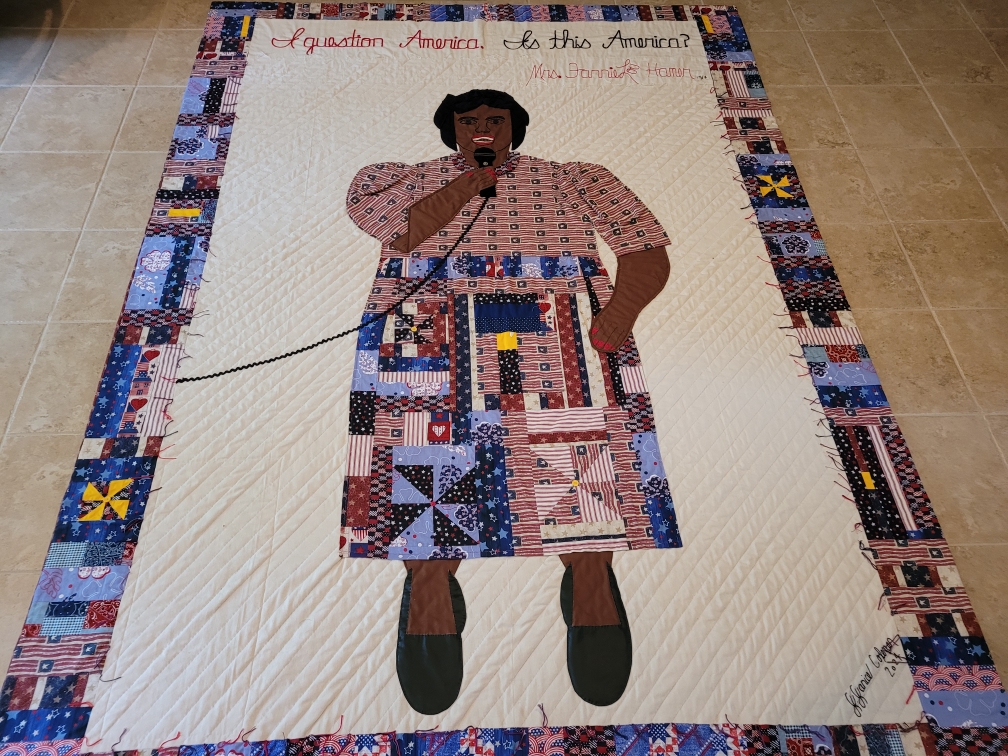
An English professor at the Mississippi HBCU Alcorn State University has sewn a quilt honoring civil rights activist Fannie Lou Hamer.
In an interview with Mississippi Today, Professor J. Janice Coleman explained her history with quilting and what led her to make a quilt honoring Fannie Lou Hamer. She began quilting when she was around 6 or 7 years old, using old cotton sacks on her family’s farm. In recent years, Coleman has used her quilts to both celebrate and teach Black History, with the Fannie Lou Hamer quilt being part of an ongoing lecture series she’s teaching at Alcorn State.
“If you’ve spent as much time sewing as I have, then you may as well share it with the students and it needs to become a part of your academic life,” Coleman told Mississippi Today.
Coleman’s use of cotton sacks to quilt holds more symbolic weight in the Fannie Lou Hamer quilt, as Hamer worked as a sharecropper in the Mississippi Delta. In 1964, Hamer was one of the key organizers of Freedom Summer, which was a campaign to increase voter registration among Black people in Mississippi. She was also instrumental in the formation of the Mississippi Freedom Democratic Party, which was an alternative to the entirely white Mississippi Democratic Party.
Hamer faced many injustices in her fight for Black voting rights. In 1962, she was fired from her job as a sharecropper for trying to vote. The following year, Hamer, along with fellow Freedom Party members, was arrested by police officers in Mississippi while traveling home from a voter registration workshop in Charleston, South Carolina. Hamer was not only jailed but also beaten by the officers, resulting in permanent damage to her eyes, legs, and kidneys.
Hamer’s efforts would be one of the factors leading to the “party switch” in the ‘60s, as many white Democrats switched to the Republican Party, as they didn’t want to be alongside Black voters.
“I think Fannie Lou Hamer was five feet, four inches tall. And on the quilt, I wanted her to be five feet, four inches tall. Life-size. Right? But the quilt got longer when I had to put the writing on the quilt, what she’s saying at the top of the quilt,” Coleman told Mississippi Today.
The quote on the top of the quilt, “I question America. Is this America?” was taken from when Hamer spoke before the Democratic National Committee in 1964.
“If the Freedom Democratic Party is not seated now, I question America,” Hamer told the DNC credentials committee. “Is this America, the land of the free and the home of the brave, where we have to sleep with our telephones off of the hooks because our lives be threatened daily, because we want to live as decent human beings, in America?”
This is not the first time Coleman has honored a legendary Black woman with her art. Coleman’s quilt honoring author Toni Morrison was displayed during the Mississippi Museum of Art’s 2024-2025 exhibit, “Of Salt and Spirit: Black Quilters in the American South.”
Fannie Lou Hamer and Toni Morrison are not the only Black women Coleman intends to honor through her art.
“I really want to put Myrlie Evers on a quilt. And not so much as a Civil Rights worker, but as a singer at Carnegie Hall,” Coleman told Mississippi Today. “I interviewed her a few years ago when she was about to turn 80, you know, she’s 90, 93 now, I believe. And she was talking about how pleased she was that she finally got to sing at Carnegie Hall.”
Coleman’s work in honoring people like Fannie Lou Hamer is truly essential, as the rights Hamer advocated and literally bled for are under attack by the modern Republican Party.
SEE ALSO:
How Fannie Lou Hamer Challenged The Status Quo
Black Women In Social Justice
Black Professor Sews Quilt Honoring Civil Rights Activist Fannie Lou Hamer was originally published on newsone.com